What is included in each post?

Hello Reader,
to understand my post I thought I write a little explaination. Each post has 3 parts.

The first part is always a summary about the pages I read that day. (Part1)

The second part is always about a part I thought was interesting and I made my own opinion about that topic or text phrase. (Part2)

The thrid and last part is always one or more links about a topic which came up during reading the part. I liked the topic and wanted to know more or didn't know what it was. (Part3)


Hope you enjoy reading.

Wednesday, September 15, 2010

The Second Night 65-78

The end of the chapter 'The Second Night'

Part1
Balram talks more about the time as ‘driver’, which is more a servant. To the driving, buying whiskey, feet massages comes washing, petting, pampering and walking the two dogs.
Mr. Ashok asked Balram to drive him to Laxmangarh because he was born there but never saw it again. So Balram drove Mr. Ashok and Pinky Madam to Laxmangarh in his own uniform and with the Honda city. That’s a grand entry form him. On the way there Pinky Madame was wondering why Mr. Ashok wasn’t driving, why they are driving there anyways and when the f*** re they flying back to America. Mr. Ashok told her, its India, the people drive crazy so no one is driving their self. He wanted to go to Laxmangarh because he was born there and haven’t been back since. About America he just said to talk about it later.
After they got food at the Storks mansion Balram went of to see his family but they were already standing around the Honda City. When Balram went over to his family Kishan raised his hand. Balrma didn’t send money the last 2 months and Kishan left 3 months ago. Kishan got really skinny and  like my father. The women take everything from him. He and the whole family was angry but not really. He got a lot of attention from the whole family, especially when the neighbours were waiting for him at the old house to see his uniform. Kusum, his grandmother, talked about his weeding in the end of the year but Balram wasn’t ready to get married. Kusum wasn’t happy with him to disagree. Balram pushed the food away, screamed NO! and walked out of the house. After half an hour he went back to the mansion where Mr. Ashok and Pinky Madam were already waiting. On the way out of the town Balram drove by all the women like Kusum and his aunt. They were really surprised he didn’t come back to apologize and got angry when he didn’t stop with the car.
Pinky Madam and Mr. Ashok were talking about the question about America. In the beginning Mr. Ashok really wanted to come to India for only 2 weeks but then he realized he could do so much more in India then in New York and the live is better, were else do they have a servant who brings tea and sweets to the bed while your still lying.

Part2
While reading the last part of the chapter I thought he is going to kill him on the way back to Dhanbad because he got scared they are flying back to America. So I’m surprised Mr. Ashok is still alive and now I’m interested in the why he is going to kill him. Mr. Ashok seems like a really good person to me. He is kind, handsome and interested in a good live. He doesn’t care as much as his brother and father that everyone around him has to work. I think that’s what makes him nicer.

Part3

This is a like about how the life is for a servant in Indian families. It was hard to find a good links so I just got one.

Tuesday, September 14, 2010

Second Night pg. 37-65

The second night 37- 65

Part1
The second later to the premier minister of china is about how Balram get’s his job as chauffeur.

It starts of with how much Balram could talk about himself and that he feels sentimental when he thinks of Mr. Ashok the man he killed. Mr. Ashok was a really kind and gentle to the people around him. Balram got to his house after a long trip.
I’ll start back in Laxmangarh when Balrams’ father was really sick. He split blood out of his mouth, that’s when Kishan and Balram took him across the river. Another rickshaw-puller on the other side who took us to a free government hospital, but no doctor was there. Balrams’ father died at six o’clock that day. Kishan’s marrige took place a month after the funeral.
It was one of the good marriages because they were able to screw the girl’s family. Balrams’ family got five thousand rupees cash, a Hero bicycle and a thick gold necklace for Kishan. Two weeks after the marriage Balram, Dilip and Kishan packed of to leave for Dhanbad. On the way to bigger cities they go throw half-baked cities for half-baked people. They started of working in a tea shop but Balram overheared conversations and figured out he could earn way more money as a driver. That’s when he started to try learning how to drive.
With his grandmothers permission he spent three hundred rupees on an old driver to teach him. For each lesson driving he had to work under the car. In the end the old driver taught him how to be a driver and not how to drive a car. They went to a brothel were he was able to choose between an American, western or Nepali woman. His first time.
Now he was trying to find a job by walking from house to house and house to house, two weeks until he finally came to Mr. Ashok’s house. At first it looked bad but he talked as long as someone, he figured out it was the stork, open the door. He talked about Laxmangarh and flattered him. Balram passed the driving test, when he got asked which caste he is in. They didn’t know because people in cities don’t really care so much. He wasn’t sure what to say but decided to tell the truth. His name is Halwai which means “sweet-maker” and those are in the bottom caste. They had only employees from the top caste so he got the job. Later Balram figured out that he was really lucky to get the job because Mr. Ashok just came back from America. Mukesh Sir made Balram a hard start and asked in Laxmangarh for information. That’s when he had the job save.
Finally he had a home, regular food and a uniform. He got 90 rupees a month the rest was for his family, like he promised. He told everyone he was a driver but actually he had to work in the house too. Cooking, cleaning, buying ‘English’ whiskey and he had to give the Stork a feet message. Normally the Storks’ sons are sitting down with whisky while Balram has to give the massage. The sons are completely different. Muskesh Sir was small, dark and ugly and married a homely wife which gained weight after having to children. He has his father’s mind which means the people around him have to work every minute.
Mr. Ashok had his father’s body, tall, handsome like a landlord’s son should be. He got married to a Christian woman in America which his father did not like at all.

Part2
Pg.53 “ “Halwai…” He turned to the small dark man. “What caste is that, top or bottom?” And I knew that my future depended on the answer to this question.

Pg. 54 “Now, the dark men – Mukesh Sir, brother of Mr. Ashok – did not know the answer – I told you that people in the cities know nothing much about the caste system, so the Stork turned to me and asked me directly. “Are you from a top caste or bottom caste, boy?””

I think it is really important to know that the cast system is no longer that influential in Indian’s cities. Every caste can work were he or she want to. I would say it is still really hard but it is possible and that’s what we have to see. It’s a good thing that the Untouchable cast is forbidden because it’s discrimination in my point of view. Just a few years ago it looked different. The cast system was really influential and every Hindu lived for the release of his soul. In the novel Balram takes the right turn by telling the truth about being in the bottom cast. I actually think the Stork and his son’s wouldn’t even care if he is in the bottom or top caste as long as he tells the truth. Mukesh Sir must call workers or friends in Laxmangarh for information about him because he just didn’t trust him. In the end everything is fine and Balram earns enough money to take care of himself and for giving it to his family like he promised.

Part 3
Caste System:
Text + picture

Text Caste System in modern India

Sunday, September 12, 2010

Finishing Cheapter One 22-36

Reading page 22-36


Part 1

Balram’s father was a hard working man and chose to fight and not to beg the landlords for work during the rain, like the rest of the working men in the village. The father had a plan and that was Balram. He wants at least one of his children to live like a man.

One day he yelled at Kusum because Balram came home from school early. Balram got scared when he saw a lizard and his classmates teased him by catching the lizard and holding it in his face. That’s why he ran home.

On the next day the father went to school with him. The classroom was still empty and so Vikram started to catch and kill the ‘monster’. Balram realized he lizard feels like he did and didn’t want his dad to kill it but it was to late.

Since that day he is back in school. A few days later a school inspector stopped by the school on surprise. He saw the classroom in a really bad shape and yelled at the teacher for stealing so much money from the school funds. They don’t have any duster, chairs or uniform at the school. The inspector also started testing one boy after the other. Balram was the only one, who was able to read, to write, to read the time and knew the Great Socialist. The man promised Balram a scholarship in another town and called him ‘The White Tiger’ because he is an intelligent and honest young man in a class full of idiots.

A ‘law’ of the darkness is if something good happens bad news will follow really soon.

That’s what happened to young Balram. His cousin got hitched off to a boy. His family had to give the boy a new bicycle, cash, a silver bracelet and they had to arrange the wedding. To celebrate a huge wedding the family took a big loan from the Stork and because he called in his loan the whole family had to work. My brother Kishan picked me up from school and we walked to the tea shop to get our work. We had to break coal into little pieces by thronging it against a brick. Classmates stopped by after school and made fun of him. Balram felt bad and his brother tried to make him feel better. To turn bad news into something good is the entrepreneur’s prerogative.

The last thing he is talking about the Black Fort, as a child he always wanted to go there but Kusum told him it is too scary to go for him. While working as a driver for Mr. Ashok he finally went there. Up there was nothing really special just the view was really pretty. He started to spat over and over again out of nothing. 8 months later he slit Mr. Ashok’s throat.


Part 2

“There wasn’t much around – just some broken walls and bunch of frightened monkeys watching me from a distance. Putting my foot on the wall, I looked down on the village from there. My little Laxmangarh. I saw the temple tower, the market, the glistening line of sewage, the landlords’ mansions – and my own house, with the dark little cloud outside- the water buffalo. It looked like the most beautiful sight on earth.” Pg 36.

He is talking about the Black Fort in this part. When he finally got up there, there was nothing but a great view. So why was he scared to go there after all? Just because someone told him the biggest lizard lives there? He just believed it and made everyone think he is a scaredy-cat. In the age of 24 he was able to proof them wrong. He made it up there and felt good about himself.
The description from on top of the Black Fort sounds pretty and like he says in the last sentence, “It looked like the most beautiful sight on earth.” Pg 36 It is ironic because everything looks beautiful from far away. The truth is the people have a bad life. They have to work there asses of to get money and then they have to split it up because the landlords get a part of it. The children have to work for the family to get there loan paid of and can’t go to school because of that. I think it’s not far and I really hope the situation is going to get better soon.


Part3

Laxmangarh
http://www.worldlingo.com/ma/enwiki/de/Laxmangarh
http://www.indianetzone.com/12/laxmangarh_rajasthan.htm


                                                                     Laxmangarh Fort


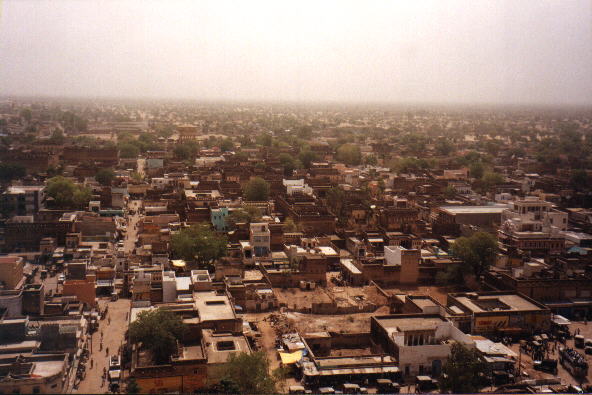
Town view of Laxmangarh

Thursday, September 9, 2010

Page 9-22

Part1

In the beginning of this reading Balram talks about his life three years ago, when he started to get a person of national importance, a lot of people saw him on the police poster. They were searching for him.


As a child he got named Balram by his teacher because his mother was to sick and his father to busy working as a rickshaw-puller, so he didn’t have time either.

Balram was born and raised in Laxmangarh, in the darkness of India where the country is full of rise and wheat fields with ponds choked with lotuses and water lilies in the middle. The India of light is close to the ocean because he brings the light to the country.

Everywhere where the Ganges flouts is the darkness. For Balram it’s the river of death which is full with rich, sticky, dark mud. In the age of 8 he went to the holiest spot at the river for his mothers’ funeral. The smell of decaying flesh was so intensive that Balram smelled the river before he actually saw him. In the end he saw his mothers’ body sinking into the mud.

Laxmangarh is not at all a tropical paradise. The electricity poles are defunct, the water pat broken and the children to skinny. The village has one street, a market with 3 almost identical shops and a tall temple. Water Buffalos are important for the family because when they have enough milk the women can sell some. It’s why it’s important to take care of the buffalo.

Like I said earlier Mr. Vikram Halwai, Balrams’ father was rickshaw-puller. He never crouched when the others did because he was a poor man with honor and courage. In Laxmngarh are 4 landlords. There is the buffalo owns the rickshaws and roads so every one who pass has to pay one third of his earned money, the stork who owns the river and get money from each fisherman and every boatman who crosses the river than his brother the wild boar owns all good agricultural land. He gets his money from his workers. The Raven owns the worst land. It’s dry and rocky so he gets his money from the goatherds which are crossing his land.

All four landlords, or animals live in huge mansions with there family and show of their money in the village since one child got kidnapped by the Naxals. So they send their children to Dhanbad or Delhi.

Each year every man in town meets at the bus station to get out of town to Delhi, Calcutta and Dhanbad for work to earn money. On month before the rains the men came back. That day the woman were waiting and hiding in the house to attack there man like wildcats to get some money. Vikram survived the city each time but during the attack from the women he lost all his money to them.


Part2

Pg 18: “ Sometimes, would you believe, I almost miss that time."
In my opinion this sentence is contrary to how he talks about his childhood and memories. He talked about that his parents didn’t even care what his name was because they were sick and busy working. I would understand if he feels upset and disappointed about it because it shows that his family connection and way of life was bad and sad, without any harmony. The family life seems cold and reserved. I believe it’s a really important fact of my childhood that I grow up with love harmony and fun. It makes me start thinking about how good the life is in Germany. We have good electricity, water, food, busses on time. We don’t really have 2 sides of our county like Balram explained. I could imagine that it’s really tough getting out of this area and start being on your one in a bigger city. Who would believe a poor country guy?
So far I really like the book, it’s interesting and I like how Aravind Adiga describes, for example on pg 22 “A moths before the rains, the men came back from Dhanbad an Delhi and Calcutta, leaner, darker, angrier, but with money in their pockets. The women were waiting for them. They hid behind the door, and as soon as the men walked in, the pounced, like wildcats on a slab of flesh. There was fighting and wailing and shrieking.”
I would say his descriptions are really detailed and he is sometimes using metaphors. I love that because I always try to imagine in my head what and how it is going on. On page 5 from the first reading I really liked the part with the chandelier. It talks randomly about the chandelier and goes over to how it looks the same in the best disco of Bangalore. I just really like how he descripts that part.


Part3

http://www.dnaindia.com/india/report_india-has-two-sides-developed-and-underdeveloped-says-rahul-gandhi_1315442

http://www.globalgateway.org.uk/default.aspx?page=1734

Tuesday, September 7, 2010

First Post, pg. 1-9

Each of my blog entry is going to have the same concept I will start out with a summary about what I read since the last entry. That is Part 1. The next Part, Part 2, will be a creative writing about an interesting part of the book or a topic that comes up more than usually. Following to the text is a link (Part 3) which refers to Part 2.


Part1

The first 9 pages of the book ‘the White Tiger’ written by Aravind Adiga are about the premier minister Wen Jiaboo and his trip to Bangalore.

The Chinese premier minister announces a visit in Bangalore. The minute Balram knows he starts writing a letter. The great man, the premier, comes to Bangalore on a mission to know the truth. Balram considers himself as a great man and a man of action and change. He thinks he is the right person for the premier to talk to. Balram admires China, Afghanistan and Abyssinia because those are the only countries that were never ruled by foreigners.
India has a lot of entrepreneurs who build the outsourcing companies that virtually run America. Balram is one of those. He believes that the premier is visiting to learn how to make Chinese entrepreneurs. Balram wants to tell the truth by telling his life story and not with those American money wasting books.
He really starts thinking about his education as his ex-employer Mr. Ashok asks him questions and he obviously answers wrong. Balram never finished schooling just as a thousand other Indians either. He talks about himself as a self-taught entrepreneur. He reads the books that count and remembers parts of the schooling e.g. sentences of history or mathematics, sentences about politics read in a newspaper or just a little hearing from the All India Radio news bulletins. He remembers differently than a man that finished school. But all these little parts come together in his head and get mixed up. The results are half-formed ideas. That’s the beginning of “The Autobiography of a Half-Baked Indian”.


Part2

What do you think about the Indian school system? How does it infect the population/ economy or society with the background information you know about the religions e.g. the Hinduism?


Reading about so many Indians not having a school-leaving diploma is a shock. I did not think that so many children aren’t able to finish school. For me it is one of the most important steps into the working life. Without a school-leaving diploma you have really bad perspectives on the job market. I think it is normally not that easy to get a good job and become an entrepreneur like Balram. I believe that most of the thousand of Indians, Balram mentions in the book, don’t have a good job and have to live really poorly. That would mean the population is mostly poor and as far as I know that’s how it is in India. But with the respect to the Hinduism and the cast system it is not too bad. (I don’t mean that in a mean way.) In the cast system are 4 casts and the untouchable ‘Cast’. It’s not meant to be a cast because the Untouchable (Dalits) do all the dirty work, like street sweeper, field workers and latrine cleaners. More than half of the Indian population falls under the global poverty line and more than 1/3 of those are Dalits.

Part3
http://eighttwosix.blogspot.com/   religious background information
http://www.globalgateway.org.uk/default.aspx?page=1732   good picture overview
http://countrystudies.us/india/37.htm   text explanation